
Synthesised from work alongside 60+ agencies including:












What's inside of this playbook
The structural patterns that show up repeatedly at $1M, $5M, and $10M. Skip to whichever revenue stage is hitting you hardest right now.
I get asked about this every week. How do top-tier DTC retention, creative and performance marketing agencies structure their teams.
My answer is always the same...
99% of the agencies you're benchmarking your team structure against are running a Frankenstein model that kind of works for them. Copying it won't work for you. We've seen enough of it.
Your team structure is an OUTPUT of strategic decisions you've already made or need to make. When you copy someone else's org chart, you're inheriting assumptions that have nothing to do with your business. That mismatch is why the structure feels like it kind of works... but also kind of doesn't.
Your structure is an output, not an input.
Every team structure in every agency is mainly built on top of 4 things:
- The pricing model and offer
- The end-to-end delivery workflow
- The client portfolio
- The talent
When your 'favourite' agency built their structure, they built it on top of THEIR version of all four. Not yours.
I've sat inside 60+ agencies at this point. And while every structure should be designed backwards from the offer, there are patterns at each revenue stage that consistently show up. Not templates. Patterns.
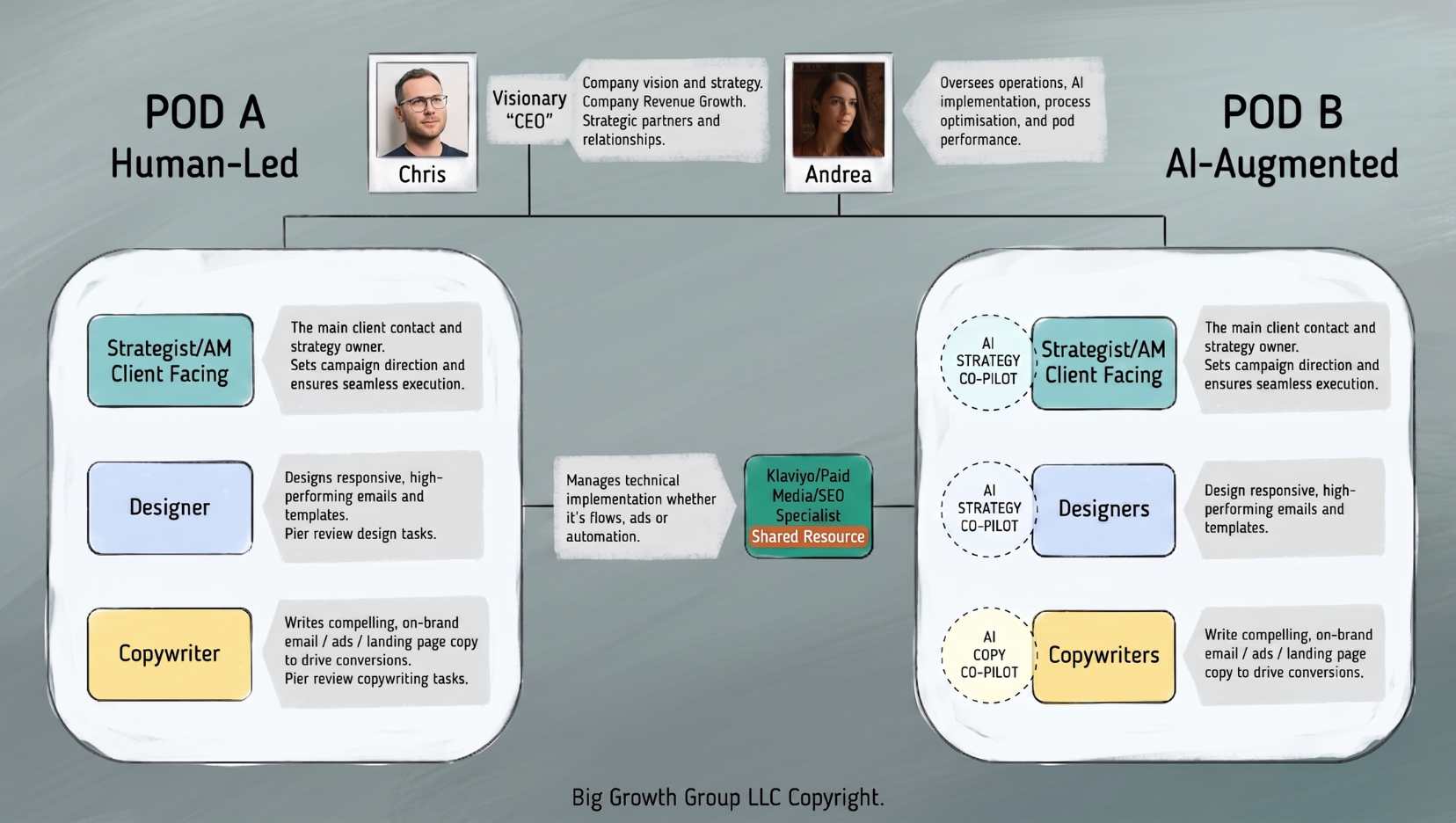
At $1M, most founders are still the load-bearing wall. You're doing strategy, firefighting, client escalations, and probably still reviewing creative.
Your team is usually 6-15 people depending on whether you're running paid media or email retention. Two pods, with shared resources.
The pod looks something like this
You don't need a dedicated Account Manager at this stage. The Strategist owns the relationship AND the strategy. Splitting those into two roles at $1M creates a game of telephone that slows everything down.
QA works through a two-peer review system. Expert checks the quality. PM checks the alignment with strategy and specs. No dedicated QA role needed yet.
AI layer at $1M
This is where most agencies start thinking about AI as a tool - Claude for copy, maybe some automation for reporting. That's surface-level. What you need to be building is a data layer underneath your pods. Your processes, your client data, your delivery workflows - all connected and queryable. Not sitting in a Google Drive folder nobody opens.
An OpenClaw/Claude + Obsidian-based knowledge system means your team stops defaulting to you for every question. The system answers instead.
Finance at $1M
Every pod should have its own P&L visibility, even at this stage. We ask "what does this pod cost to run and what does it produce?" If you don't know your cost-per-pod and revenue-per-pod, you're essentially scaling blind.
One of our clients reached $1M ARR with a single pod. Another needed three pods at the same revenue because their pricing was lower and their ICP is different. Same revenue, completely different structures.
People at $1M
There's a pattern we see at pretty much every $1M agency. The founder hires "helpers" - people who take tasks off their plate. Helpers follow instructions without asking why. They come to you with problems instead of solutions. They complete tasks but they don't move the business forward.
What you actually need at $1M is owners. People who take full responsibility for their role and results. People who solve problems independently and only escalate when necessary.
The difference sounds obvious when you write it down but the reality at $1M is that founders are still the only owner in their business. Everyone else is helping. And that's a big part why the founder is still the load-bearing wall.
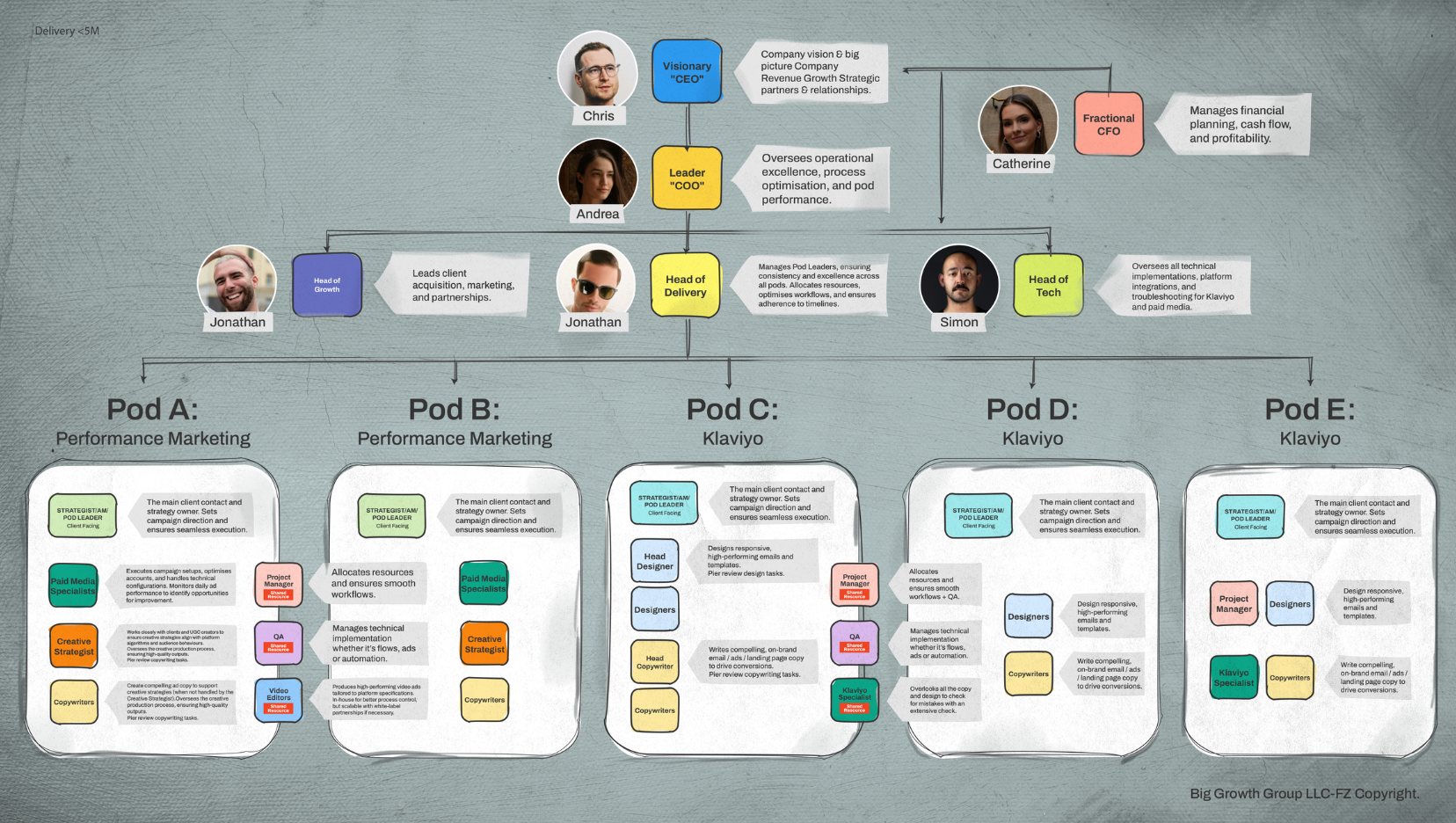
At $5M, your pods need to function like mini-agencies. Team size is typically around 50-70 people with 7-11 pods supported by a centralised system. But again, the number of pods depends on your service, pricing, and non-billable staff. Each pod should be tracked with its own KPIs and contribution margin.
Clients communicate directly with the Pod Leader, which eliminates miscommunication and speeds up decision-making. The Pod Leader has the deepest understanding of both the client's goals and the execution. They're fully accountable for the client's success, which drives a higher level of engagement than any AM handoff ever could.
Now - are PMs, CSMs and AMs useless? Of course not. The roles solve real problems when they're defined properly and the systems support them. But at $1M-$5M, most agencies are better served by a Pod Leader who owns the full relationship. The split comes later, if at all.
Pod Leaders Alignment
Now we have the pods but they're not talking to each other. And the founder and/or ops lead is still the only person who sees the full picture.
Two meetings fix this:
AI layer at $5M
Your goal is to integrate AI into the operating system of the business. The data layer we talked about at $1M should now be mature - your team queries the system instead of messaging you on Slack.
But there's also a bigger operational shift: AI starts replacing certain roles or fundamentally changing what those roles look like. Your retention strategist might now be managing an AI Co-pilot that builds strategy and does E2E client research instead of doing it manually. Your creative team might be producing 3x the output with AI-assisted design and copy. This changes your pod economics. It changes your headcount requirements. It changes your margins.
We, as founders, have to be honest about what this means. A pod that needed 5 people two years ago might need 3 today.
Finance at $5M
Every pod is a profit centre. Revenue per pod, cost per pod, contribution margin per pod.
This is where the Fractional CFO becomes critical. At $5M you're making decisions about which pods to invest in, which to restructure, which services to sunset. Those decisions must be based on financial data.
The agencies that get stuck between $3M and $5M are almost always the ones making structural decisions by feel instead of by numbers.
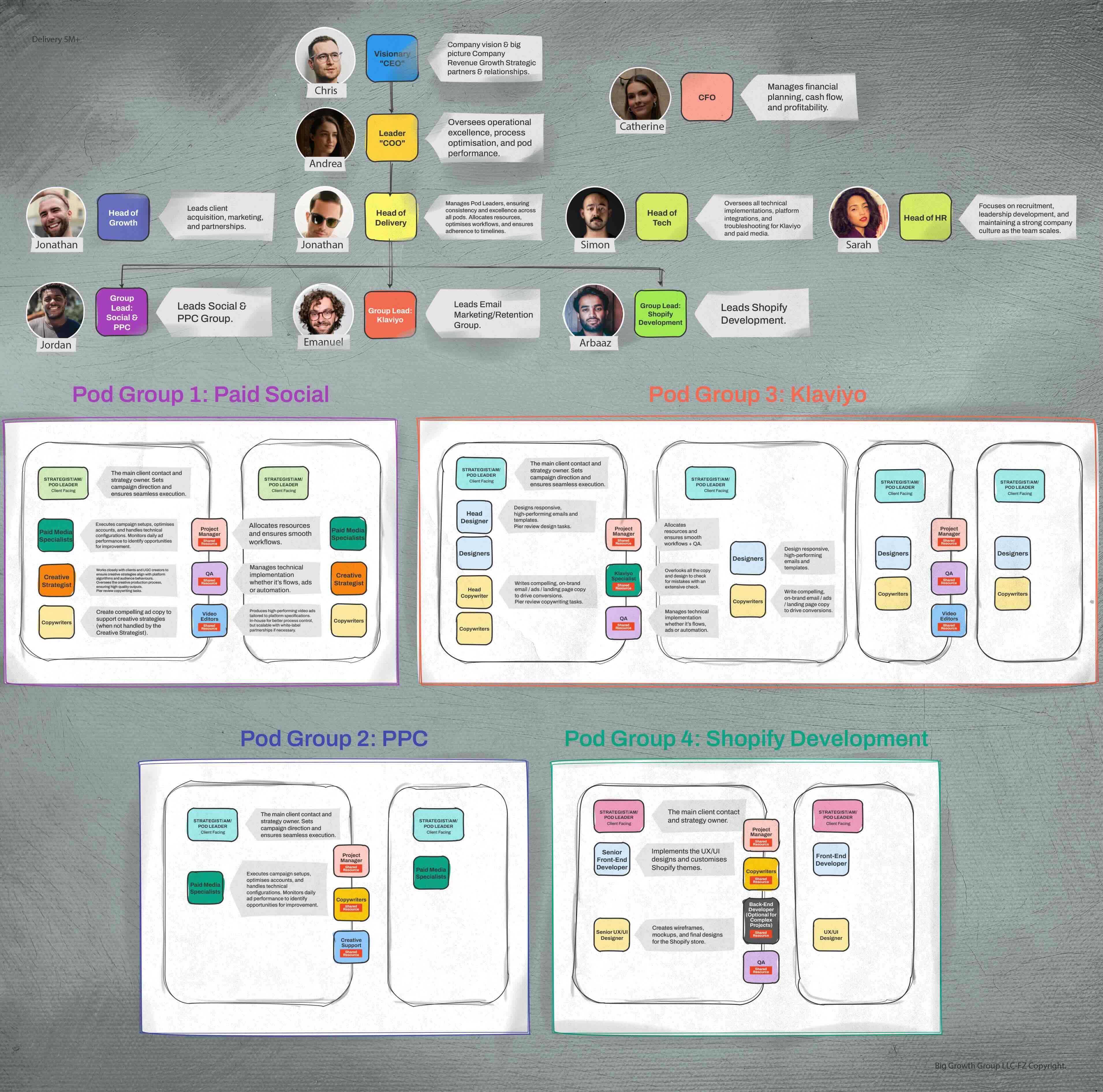
At $10M, pods are fully autonomous. Each one operates like a mini-agency, owning delivery, results and profitability for their client roster.
The big structural addition: Group Leads. Middle management that actually works. Each Group Lead manages 3-4 pods, acts as the bridge between the Leadership Team and Pod Leaders. They monitor pod performance, drive cross-pod collaboration, and mentor Pod Leaders.
At this stage you're probably running multiple services. Social ads, email retention, PPC, maybe Shopify development or creative production. Pods are grouped by service type for focus and consistency.
Talent at $10M
Nik Storonsky, founder of Revolut, talks about categorising team members as:
- Self-guided missiles
- Excellent
- Strong
- Average
- Below Average
The founders who tolerate average performers at this stage spend their days micromanaging. The ones who set clear standards and act quickly when someone isn't delivering scale with less stress because their teams own results, not just tasks.
This is about standards and decisiveness. How clear are you about what excellence looks like? How long are you willing to wait before making a change? How honest are you with yourself about the people who aren't performing?
I've seen this play out in agencies repeatedly. The founders who keep average performers because they're nice or because replacing them feels risky... they spend their days in the weeds, micromanaging, stuck.
Design it backwards from your offer.
Your structure is designed backwards from your offer. From your pricing model. From your delivery workflow. From your client portfolio. From your talent. From your financial model. And now, from your AI capability.
Get those foundations right and the structure becomes obvious. Copy someone else's org chart without those foundations and you end up with something that looks vaguely right but doesn't actually function.
Design it backwards from your offer. Not forwards from someone else's org chart.
Want to know what structure actually fits your agency?
The Founder Dependency Audit diagnoses where you're still the load-bearing wall and what structure your offer, pricing, and margins can actually support. We work through it together.
See where your agency depends on you- Romans